What Are the Top 10 Most Important SEO Tips and Hacks?
These are not hacks. They are fundamentals that consistently move the needle: one keyword per page, title tags under 60 characters, location pages for every area you serve, a fully built Google Business Profile, Core Web Vitals, FAQ schema, internal linking, Google reviews, writing for humans, and GA4 set up correctly.
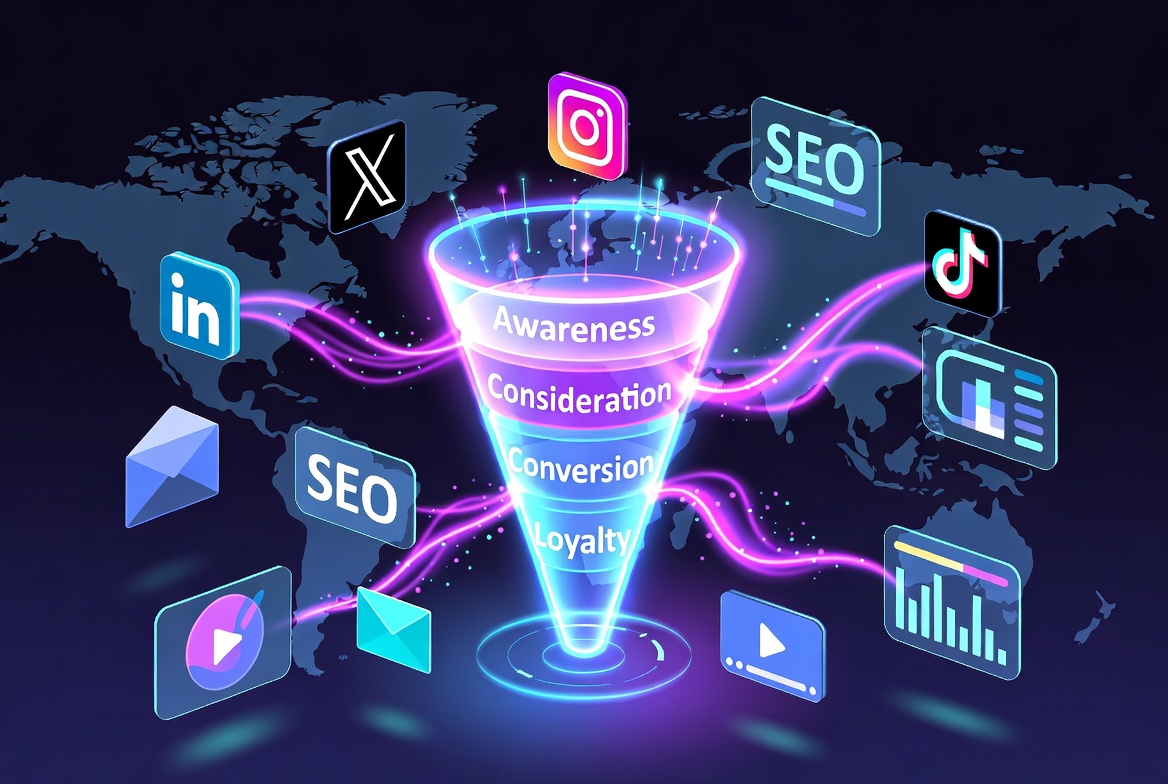
The digital advertising funnel: how SEO and paid search work together at each stage of the customer journey.
One keyword per page. This is the most violated rule in local SEO. A single page that tries to rank for plumber, emergency plumber, plumber near me, and 24 hour plumber simultaneously will rank well for none of them.
Pick one primary keyword per page and build the entire page around that term: title tag, H1, first paragraph, and URL all pointing at the same target.
Title tags under 60 characters with the keyword near the front. Google rewrites title tags it considers irrelevant or too long.
A title like Google Ads Management for South Jersey Home Service Businesses is 63 characters and will likely get truncated or rewritten. Keep it tight, lead with the keyword, and end with the brand name.
Google Ads Management in South Jersey | Baz Strategy is 53 characters and much more likely to appear as written.
A fully built Google Business Profile with the right primary category, all services listed, photos updated in the last 90 days, and consistent review responses. More than half the GBP profiles we audit are missing at least two of these.
The primary category alone can move map pack rankings for competitive local queries.
Core Web Vitals above the threshold. Google uses Largest Contentful Paint, Cumulative Layout Shift, and Interaction to Next Paint as ranking signals. Check your scores in PageSpeed Insights and in Google Search Console's Core Web Vitals report.
A site that fails these metrics is at a ranking disadvantage to a comparable site that passes them, all else being equal.
FAQ schema on every page that has questions and answers. This is still underused by most local businesses and it gives Google structured data to pull into search results as rich snippets.
A service page with properly implemented FAQ schema can appear as an expandable FAQ directly in the search results, increasing click-through rate significantly.
Internal links connecting related pages. Every blog post should link to the relevant service page. Every service page should link to related service pages and relevant blog content.
Internal linking tells Google which pages are most important and distributes the authority built by your inbound links across the site.
Location pages for every area you serve. A plumber who serves Margate, Ventnor, Atlantic City, and Ocean City should have four separate location pages, each targeting the specific town.
One general South Jersey page competing against four targeted location pages will lose every time to the more specific approach.
Reviews on Google, not just volume but recency and response rate. Google's algorithm for local pack rankings weights recent reviews. Getting five reviews in a week is better than getting fifty over three years.
Responding to every review, including negative ones, signals active management and is factored into ranking calculations.
An XML sitemap submitted to Google Search Console with no broken URLs, duplicate content issues, or pages blocked by robots.txt. This is basic infrastructure but it is wrong on more sites than it should be.
A sitemap with 404 errors is worse than no sitemap at all because it directs Googlebot to dead ends.
GA4 set up correctly with conversion tracking that captures the actual conversion event, not just a page visit.
An analytics setup that cannot distinguish between a visitor who left after 10 seconds and one who submitted a contact form is providing data that cannot be acted on.
Every marketing decision should trace back to an event that actually represents value to your business.