The Case for Adding Bing Ads to Your Paid Search Mix in today
Most advertisers put 100% of their search budget into Google and ignore Microsoft Advertising entirely. That is a mistake. Lower CPC, strong demographics, and the LinkedIn targeting layer make Bing one of the best incremental wins available right now.
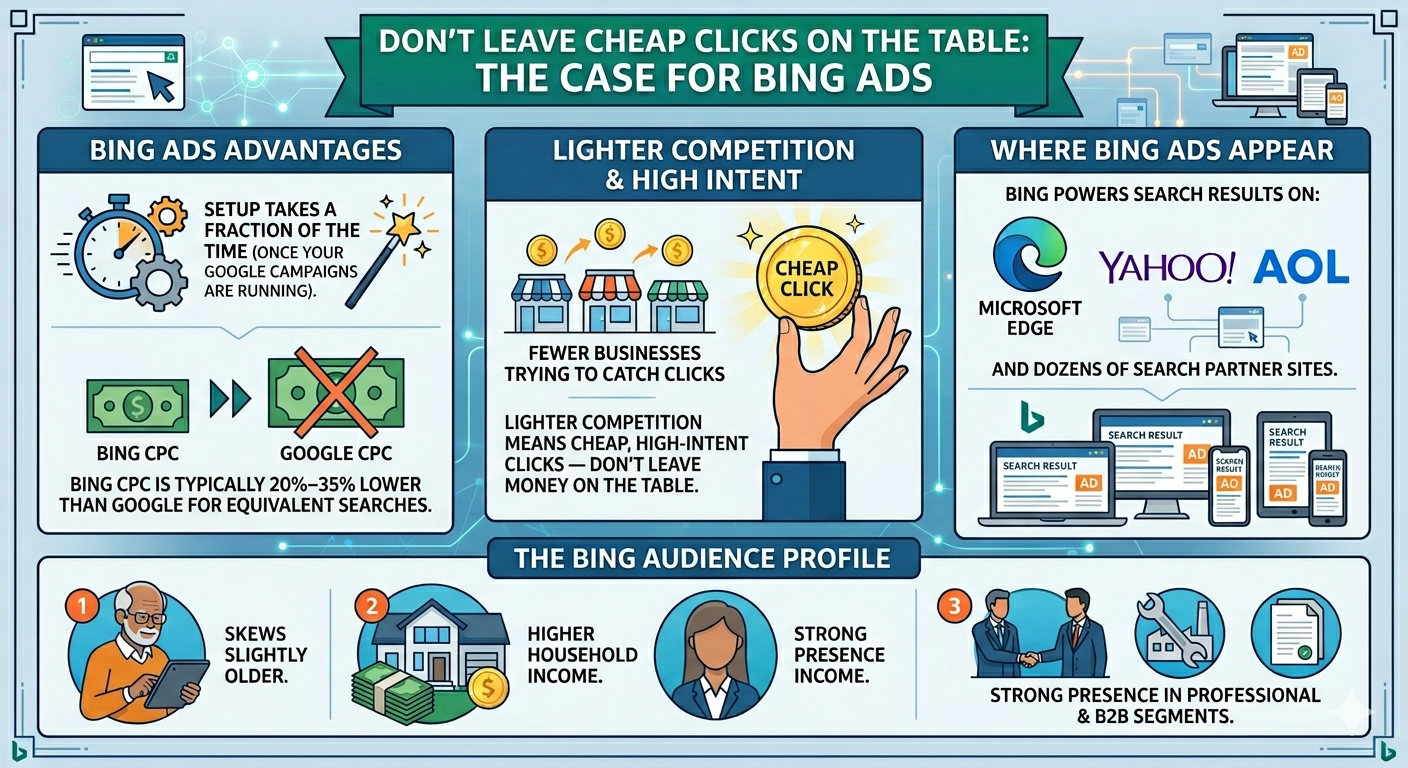
The case for Bing Ads: lower CPC, lighter competition, and a high-intent audience most brands are leaving behind.
Microsoft Advertising, which powers search ads on Bing, Yahoo, and AOL, reaches roughly 50 million desktop searchers in the US that Google does not reach. That number is smaller than Google's total search volume, but it is not zero.
For most advertisers, Bing represents 15 to 25 percent of total search volume in their category, and the traffic is consistently cheaper.
The demographic profile of Bing searchers skews older and higher-income than Google. The median Bing user is 45 or older, has a higher household income than the average Google user, and is more likely to use a desktop computer.
For home service businesses targeting homeowners rather than renters, for luxury goods, for financial services, and for B2B products, that demographic is not a weakness. It is a feature.
The practical argument for adding Bing is the cost. CPC on Microsoft Advertising runs 20 to 40 percent below Google for most categories.
For a landscaper, roofer, or pool installer spending two thousand dollars a month on Google, adding five hundred dollars to Bing can produce comparable results to adding that same five hundred to Google, because the competition for clicks is lower and the buyer intent is equivalent.
The setup cost is minimal because Microsoft Advertising lets you import your existing Google Ads campaigns directly. The keyword lists, ad copy, and campaign structure you have already built for Google migrate in a few clicks.
You will need to adjust bids and review the imported campaign before going live, but you are not starting from scratch. For an existing Google advertiser, adding Bing is an afternoon of work with months of incremental return.